



Maryland Second Degree Assault Lawyer: Section 3-203 Defense
Second degree assault is the most commonly charged crime of violence in Maryland, and the charge covers far more conduct than most people expect. Our assault trial attorneys defend these cases statewide, from District Court bench trials to Circuit Court jury trials, and this guide explains Criminal Law Section 3-203: what the State must prove, the penalties, the felony enhancement, and the defenses that actually win.
If you have been charged, call us 24/7 at (877) 343-1031 or use our contact form for a free consultation. A second degree assault lawyer who prepares for trial changes how prosecutors price your case from the first court date.
First charge ever? Our companion guide on first offense second degree assault outcomes covers what typically happens to first-time defendants: probation, PBJ, and record consequences.
We've defended more than 291 domestic violence matters since 2022, from misdemeanor second-degree assault to complex felonies involving protective order violations and contested allegations. We've helped the majority of our DV clients avoid a conviction -- through PBJ, nolle prosequi, stet, dismissal, or acquittal -- protecting them from permanent criminal records and the serious collateral consequences that follow a DV conviction. In many of our DV cases, the charges were dismissed, nolle prossed, stetted, or resolved by acquittal -- without our client pleading guilty.
Verified internally; last updated: Oct 14, 2026.
Understanding Second Degree Assault in Maryland
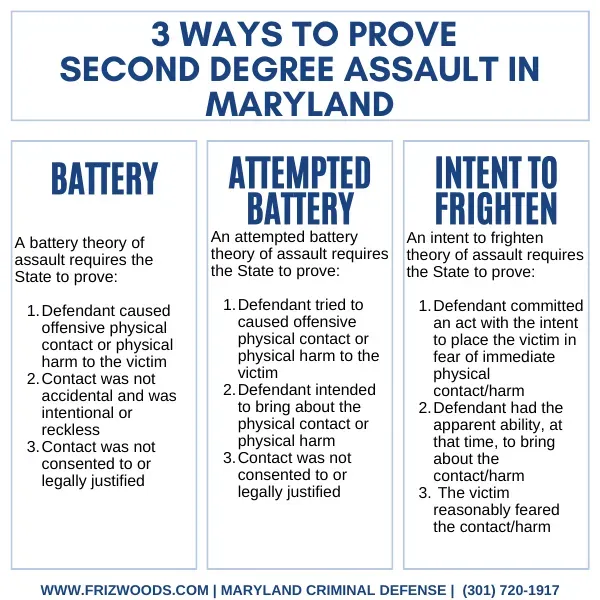
Under Criminal Law Article Section 3-203, second degree assault carries up to ten years in prison and a $2,500 fine. The statute sounds simple, but Maryland groups three separate theories under "assault":
- Battery: intentional, nonconsensual harmful or offensive physical contact.
- Attempted Battery: an intentional but unsuccessful attempt to cause physical harm, with present ability.
- Intent to Frighten: conduct intended to place the victim in reasonable fear of an immediate battery, with apparent present ability to carry it out.
Notably, self-defense can often negate these charges when justified by law.
Penalties and offense grading
| Version of the charge | Classification | Maximum penalty |
|---|---|---|
| Second degree assault (Section 3-203(b)) | Misdemeanor | 10 years, $2,500 fine, or both |
| Assault on law enforcement or first responder with physical injury (Section 3-203(c)) | Felony | 10 years, $5,000 fine, or both |
The felony version under Section 3-203(c) requires intentionally causing "physical injury" (any impairment of physical condition, excluding minor injuries) to someone the defendant knows or has reason to know is an on-duty law enforcement officer, parole or probation agent, firefighter, EMT, rescue squad member, or other first responder. Compare penalties with assault on law enforcement and first-degree assault.
Sentencing at a Glance
| Factor | Typical Range/Outcome |
|---|---|
| Statutory maximum | Up to 10 years' incarceration; fines possible |
| First-time cases | Often probation; jail possible based on facts |
| Aggravating factors | Injury, prior record, vulnerable victim |
| Alternatives | Probation, treatment, community service, STET/PBJ in some matters |
The Legal Intricacies of a Second Degree Assault Charge
Prosecutors must prove several elements in second-degree assault, such as intent, lack of consent, and the defendant's present ability to cause harm. For instance, proving "Intent to Frighten" requires showing the defendant intended to place the victim in fear of immediate harm and had the apparent ability to carry out that harm.
Common examples:
- A punch that causes pain or visible injury (battery)
- Grabbing someone's wrists, pushing, or slapping them (battery)
- A swing that misses but was intended to hit (attempted battery)
- Rushing at someone with a raised fist causing reasonable fear of immediate contact (intent to frighten)
- Threatening someone with a knife or another object in a way that creates immediate fear (intent to frighten)
Second degree assault does not always require an injury or completed physical contact.
Reckless conduct without the required intent may fit reckless endangerment rather than assault. When prosecutors charge an in-progress offense rather than a completed one, see attempted crimes in Maryland for how "attempt" is proven.
Maryland also recognizes "reasonable physical force by a parent or guardian for discipline" as a defense, provided it does not become excessive or cruel. Learn more from our post on spanking and child discipline.
Defenses that win Maryland assault cases
Self-defense and defense of others. Once there is some evidence of self-defense, the State must still prove guilt beyond a reasonable doubt. Force must be proportional. Maryland generally requires a duty to retreat before using deadly force in public if safe to do so. There is no duty to retreat at home.
Consent. In limited contexts, consent can negate an element of battery.
Lack of intent or accident. Assault is intent based. Accidental contact is not enough.
Identity and proof gaps. We challenge credibility, video interpretation, medical causation, and chain of custody.
Explore more approaches in our post on defending assault charges and our guide on how to beat a second-degree assault charge.
Prefer to speak with a lawyer now? Request a free consultation and we will map out defenses and next steps.
Court process: what to expect

Max Frizalone
Founding partner of FrizWoods LLC known for courtroom-first strategy and client-focused advocacy.
- Former Prince George's County State's Attorney and Maryland Public Defender.
- Handled serious cases including carjackings, attempted murder, armed robbery, and violent felonies.
- A thoroughly reviewed criminal lawyer with a track record of trial wins in high-stakes felony and misdemeanor cases.

Luke Woods
Veteran trial attorney with decades of criminal defense experience across Maryland courts.
- Over 20 years of experience in Maryland criminal courts
- Handled thousands of cases and 100+ trials.
- Extensive motion practice, jury/bench trials, and complex felony litigation.
Most cases begin in District Court with an initial appearance and conditions of release. From there:
- Negotiations and motions on discovery, suppression, and evidentiary issues
- Election of court: you may demand a jury trial or the State may indict to send the case to Circuit Court. Learn about Circuit Court vs. District Court and what it means to have a jury trial prayed
- Trial: we frame the theory, request tailored instructions, and press reasonable doubt themes
Questions about probation terms or violations? Start with our resource on probation violations.
Domestic relationship cases
When allegations involve partners or family, courts may impose no contact conditions, counseling, or protective orders. A domestically related finding can trigger federal firearm exposure even with PBJ. Read our domestic assault guide and our post on the consequences of an assault conviction.
Expungement and record relief
Eligibility depends on the disposition:
- Acquittal, dismissal, or nolle pros: often expungeable immediately.
- PBJ: commonly expungeable after a statutory wait if you remain charge free and meet conditions. See our PBJ update: new probation before judgment law
- Conviction: relief exists but with longer waits and strict conditions
Review our Expungement Guide or ask us to evaluate your eligibility.
First vs. second degree: quick comparison
Table: Maryland Assault Quick Compare
Screen reader note: three columns compare statute, elements, and penalties for Assault 1 and Assault 2.
| Feature | First-Degree Assault (Assault 1) | Second-Degree Assault (Assault 2) |
|---|---|---|
| Statute | Crim. Law Section 3-202 | Crim. Law Section 3-203 |
| Classification | Felony | Misdemeanor by default. Felony if protected person enhancement applies |
| Core elements | Intent to cause or attempt to cause serious physical injury, or assault with a firearm | One of three: battery, attempted battery, or intent to frighten |
| Injury level required | Serious physical injury element, strangulation, or firearm use | No serious injury element required. Offensive contact or reasonable fear of immediate offensive contact can qualify |
| Weapon factor | Firearm involvement is a basis for Assault 1 | No automatic weapon factor, though facts may affect sentencing |
| Protected person enhancement | Not a separate enhancement under Section 3-202 | Becomes a felony if the defendant intentionally causes physical injury to an on duty law enforcement officer, probation or parole agent, firefighter, EMT, or other first responder |
| Maximum incarceration | Up to 25 years | Up to 10 years |
| Maximum fine | Not specified like Assault 2 fines | Up to 2,500 dollars for the misdemeanor version. Up to 5,000 dollars if the protected person enhancement applies |
Frequently Asked Questions about Second Degree Assault
What is assault in the second degree in Maryland?
It covers three theories: battery, attempted battery, and intent to frighten. The default penalty is up to 10 years and $2,500.
Is Second Degree Assault in Maryland ever a felony?
Generally, second-degree assault is a misdemeanor. However, assault on law enforcement or first responders can be charged as a felony if physical injury occurs, with a fine up to $5,000.
How does Second Degree Assault differ from First Degree Assault?
First Degree Assault is a felony involving serious bodily harm or use of a firearm/weapon, carrying up to 25 years. Second-degree assault often applies where injuries are less severe or no weapon is used.
Typical sentence for second degree assault
A first-time offense might lead to supervised probation or, in more serious scenarios, jail time. The statutory maximum is ten years in prison, but that severe sentence is unusual for a first offense.
How many years do you get for assault in Maryland?
Penalties vary by degree. For 2nd-degree assault, up to ten years' incarceration is possible under Maryland law.
What about third degree assault in Maryland?
Maryland law does not define a "third-degree assault." Only first and second-degree assault statutes exist in this state.
What does intent to frighten require?
An intentional act that causes reasonable fear of an immediate battery, plus apparent present ability and the specific intent to cause that fear.
Does the other person have to be physically injured?
No. Second degree assault can be based on attempted battery or intent to frighten even when no physical contact or injury occurs.
How can you get second degree assault charges dropped?
Dismissals can involve demonstrating self-defense, challenging witness credibility, or proving insufficient evidence. Negotiated outcomes like diversion or placement on the STET docket may also be available.
Is second degree assault a crime of violence in Maryland?
It can be considered a "crime of violence" for certain legal contexts, such as firearm disqualification. However, it is not categorized as a crime of violence under certain parole guidelines in the correctional services article.
Can a second-degree assault case be expunged?
Non convictions and many PBJs have pathways after a waiting period. Convictions may be expungable only after longer timelines. Ask us to review your history.
Do I need a lawyer for a second degree assault charge?
Yes. The charge carries up to 10 years, and outcomes swing widely based on preparation. A lawyer can raise self-defense, challenge the complaining witness's account, negotiate for STET or PBJ dispositions that protect your record, and try the case when the State cannot prove intent.
How much does a second degree assault lawyer cost in Maryland?
Most assault cases are billed as a flat fee that depends on the court, the facts, and whether the case is domestically related. We quote the fee at your free consultation and offer payment plans.
How FrizWoods LLC Helps You Navigate a Second Degree Assault Charge
At FrizWoods LLC, we prioritize clear communication and comprehensive defense strategies. Our team reviews every aspect of your arrest, from the circumstances surrounding the alleged assault to any possible legal justifications. Our collective goal is to protect your rights and minimize the lasting impact on your life.
Local Knowledge & Proven Expertise
We represent clients in Prince George's County, Anne Arundel County, Howard County, and beyond. Our attorneys know how each jurisdiction handles assault charges, helping us craft defenses tailored to the local court's procedures and tendencies.
What Our Clients Say
See the difference in our client-centered approach by visiting our reviews page. Read firsthand testimonials from individuals we've successfully represented for assault and other criminal charges.
Contact Our Maryland Assault Defense Team
If you're facing second-degree assault charges in Maryland, early legal intervention can make a significant difference in your case. FrizWoods LLC stands ready to fight on your behalf, ensuring your story is heard and your rights are upheld.
Contact us today or call our office to schedule a consultation. Together, we'll develop a clear plan to address your charges head-on and pursue the best possible result.
Related resources
- First offense second degree assault
- Protective orders in Maryland
- Peace orders in Maryland
- Protective vs Peace Order: Quick Guide